
Wow,
I had forgotten about this blogposting option on Google. It is very friendly. If you are on Google+ it is also easy to connect to and read what ever worthwhile news I am posting.
This past week I journeyed to the garden over at Christ United Methodist Church in Roswell. (BTW - if you want a garden plot, there are a few left. With our excess rain and late start to warm temps, it could be more successful than those of us already started!)
With a few more days of sunshine I am sure to harvest a tomato this week. I already gathered a half dozen very small crook neck squash, likely my only ones since the "BUGS" have arrived. Those young squash made it into a salad this past weekend and they were incredibly sweet. That was one of those accidental discoveries!
What do you want to know more about? Vexing questions on a pouty perennial? Annuals that are long and not so pretty already, or excess rain got you seeing yellow? This rain is bringing its share of challenges and I will address some of them in the days to come.
Good Gardening!
Lyn
P.S. I'll figure out how to get the iPad photos on here soon!
Tuesday, June 25, 2013


Friday, January 28, 2011
Electronics recycling - Sat., January 29
The Credit Union of Georgia is sponsoring an Electronics Recycling Day to be held at the KSU Center located at 3333 Busbee Drive, Kennesaw on Saturday, January 29th from 9am - 1pm. Bring your non-working or unused electronics to the KSU Branch of the Credit Union of Georgia and a truck will be located in the south parking area to accept your items. A $10 fee will apply for disposal of CRT TVs per TV. See attachment for more details or visit:
www.CUofGA.org
www.CUofGA.org
Friday, January 21, 2011
In the quiet time of winter
January is best left to Old Man Winter and dreams of summer bounty. It has been a tough winter thus far, and only time will tell which treasures survived our sub-freezing temps and which ones did not.
Most plants selected for our zone (7a/b across the metro area, north to south) are not extremely tolerant below 24º. We've had a few dip lower this year. But, the good news is, most of those happened following a covering of snow, which acts like an insulator, unlike conditions outlined in my earlier comments this winter about the devastating effects of cold and wind combined.
 January is a great time to force bulbs like paperwhites and hyacinth. They add a heady fragrance to the doldrums of winter. I have started an amaryllis (a little late, but hoping for success!) I'm posting a photo from the Conservatory at Centennial Park in Seattle (July2010) to keep you enthused...my own experiment did not produce a flower, but a lot of new growth. My conclusion is I need more sun...so there is hope yet!
If we get a mild day (and we surely will!) in the next few weeks, go out and poke around, looking for signs of life and greenery. And be thinking of what you want to add to the garden this year. Something I've learned from the nursery business over the past few years - the best stock is available in March. If there is something specific you want, you need to be sure to get it before it is gone...
Stay Warm!
Lyn
Most plants selected for our zone (7a/b across the metro area, north to south) are not extremely tolerant below 24º. We've had a few dip lower this year. But, the good news is, most of those happened following a covering of snow, which acts like an insulator, unlike conditions outlined in my earlier comments this winter about the devastating effects of cold and wind combined.

If we get a mild day (and we surely will!) in the next few weeks, go out and poke around, looking for signs of life and greenery. And be thinking of what you want to add to the garden this year. Something I've learned from the nursery business over the past few years - the best stock is available in March. If there is something specific you want, you need to be sure to get it before it is gone...
Stay Warm!
Lyn
Recycling old electronics
Did Santa bring you a fancy new gadget or TV for Christmas? If you need to dispose of some other old electronics, here is your opportunity:
The Credit Union of Georgia is sponsoring an Electronics Recycling Day to be held at the KSU Center located at 3333 Busbee Drive, Kennesaw on Saturday, January 29th from 9am - 1pm. Bring your non-working or unused electronics to the KSU Branch of the Credit Union of Georgia and a truck will be located in the south parking area to accept your items. A $10 fee will apply for disposal of CRT TVs per TV. Visit the website for more details...
www.CUofGA.org
The Credit Union of Georgia is sponsoring an Electronics Recycling Day to be held at the KSU Center located at 3333 Busbee Drive, Kennesaw on Saturday, January 29th from 9am - 1pm. Bring your non-working or unused electronics to the KSU Branch of the Credit Union of Georgia and a truck will be located in the south parking area to accept your items. A $10 fee will apply for disposal of CRT TVs per TV. Visit the website for more details...
www.CUofGA.org
Saturday, November 6, 2010
Frost protection measures
Here are ways to protect your tender plants from frost:
1) Water thoroughly before dusk. Watering provides insulation in the root system, when it dries it is displaced with air, which is also an insulator.
2) Cover before the sun goes down. Use the day's sun (and heat) by trapping it around your plant(s). A number of covering options exist:
* Milk Jugs with the bottom cut off * Old sheets draped over the top * Create a teepee with sticks and wrap damp newspaper or towels around it.
3) Elevate your pots in a protected area. Frost is going to settle in the lowest places.
4) Paint your jugs or bottles black and fill with water. Place them around the plant and the heat they absorb during the day will translocate to keep the plant warm overnight.
5) Bring them inside! Obviously doesn't work for all plants...but I bring my Mandevilla in every winter to the garage and water it lightly once a week or so. Three years later it is still blooming for me in summer.
To get your plants Winter-hardy, stop fertilizing in September, and get your winter crops in by early October to establish a good root system early.
In the garden,
Lyn
1) Water thoroughly before dusk. Watering provides insulation in the root system, when it dries it is displaced with air, which is also an insulator.
2) Cover before the sun goes down. Use the day's sun (and heat) by trapping it around your plant(s). A number of covering options exist:
* Milk Jugs with the bottom cut off * Old sheets draped over the top * Create a teepee with sticks and wrap damp newspaper or towels around it.
3) Elevate your pots in a protected area. Frost is going to settle in the lowest places.
4) Paint your jugs or bottles black and fill with water. Place them around the plant and the heat they absorb during the day will translocate to keep the plant warm overnight.
5) Bring them inside! Obviously doesn't work for all plants...but I bring my Mandevilla in every winter to the garage and water it lightly once a week or so. Three years later it is still blooming for me in summer.
To get your plants Winter-hardy, stop fertilizing in September, and get your winter crops in by early October to establish a good root system early.
In the garden,
Lyn
Frosty morning to you!
Earlier this week, when I was dreading the coming frost, I came across this beautiful bit of writing from Nathaniel Hawthorne's "The American Notebooks". It changed my whole outlook...
"Last night, there came a frost, which has done great damage to my garden...It is sad that Nature will play such tricks on us poor mortals, inviting us with sunny smiles to confide in her, and then, when we are entirely within her power, striking us to the heart."
You who have a connection to your gardens will relate, I'm sure.
Awed by nature,
Lyn
"Last night, there came a frost, which has done great damage to my garden...It is sad that Nature will play such tricks on us poor mortals, inviting us with sunny smiles to confide in her, and then, when we are entirely within her power, striking us to the heart."
You who have a connection to your gardens will relate, I'm sure.
Awed by nature,
Lyn
Friday, October 22, 2010
Don't Miss It! This Saturday, Oct 23
Down-to-earth and witty, humorous writer, Renea Winchester is signing her book at the farm where the story unfolded. And you don't have to have a green thumb to love her stories!
YOU ARE INVITED TO
Celebrate the gift of friendship and the release of
"In The Garden With Billy:
Lessons About Life, Love, and Tomatoes"
by Renea Winchester
Saturday, October 23, 2010 from 2- 4 pm at the home of Billy Albertson
located at 525 Hardscrabble Road, Roswell GA 30075
Please email Renea at renea(dot)winchester@yahoo(dot)com to RSVP and receive parking instructions. (Also on FB, look up the title)
Billy and Renea will be on hand to sign copies of the book. Copies are also available at www.littlecreekbooks.com, www.reneawinchester.com, Barnes and Noble, and independent bookstores everywhere.
Copyright 2010
ISBN: 978-0-9843192-5-1
www.Littlecreekbooks.com
Go. You'll be glad you did :-)
Lyn
Make and Take a Rainbarrel home
Hey Folks,
Wouldn't it be great to start the Spring out with extra water on hand? We get the highest percentage of rain in the month of February in Georgia. If you have a rainbarrel, you could be ahead of the weatherman!
Make one for cheap this weekend - details here:
http://watershed.cobbcountyga.gov/files/rainbarrels.htm
And here's another site to give you the low-down on rainbarrel use -- like, 1/2 inch of rain on 1000 square feet of roof area will yield 300 gallons of water!
http://www.rainbarrelguide.com/
I don't know about you, but my water bill just went up about 20% last month. Adding a rainbarrel to your yard is a no-brainer. Get out there a get one for yourself, and catch some free water!
Lyn
Wouldn't it be great to start the Spring out with extra water on hand? We get the highest percentage of rain in the month of February in Georgia. If you have a rainbarrel, you could be ahead of the weatherman!
Make one for cheap this weekend - details here:
http://watershed.cobbcountyga.gov/files/rainbarrels.htm
And here's another site to give you the low-down on rainbarrel use -- like, 1/2 inch of rain on 1000 square feet of roof area will yield 300 gallons of water!
http://www.rainbarrelguide.com/
I don't know about you, but my water bill just went up about 20% last month. Adding a rainbarrel to your yard is a no-brainer. Get out there a get one for yourself, and catch some free water!
Lyn
Have you seen a lot of little round, brown bugs lately?
I have, and I am thankful my curiosity got the better of me. I was thinking they looked like an undeveloped ladybug, but I had never seen these before. They are relatively new, first ID'd in 2009.
Today I checked out the ultimate guru's website, Walter Reeves, and found out a little bit more about the Kudzu bug...photos and more advice here:
http://www.walterreeves.com/gardening-q-and-a/kudzu-bug-identification/
They like to live in the walls of indoor spaces, and they congregate by the thousands, so be sure you have your exterior windows and doors well sealed and caulked!
Hope you are taking advantage of this cooler weather to plant some trees and shrubs.
More timely tips coming this week as we change seasons,
Lyn
Today I checked out the ultimate guru's website, Walter Reeves, and found out a little bit more about the Kudzu bug...photos and more advice here:
http://www.walterreeves.com/gardening-q-and-a/kudzu-bug-identification/
They like to live in the walls of indoor spaces, and they congregate by the thousands, so be sure you have your exterior windows and doors well sealed and caulked!
Hope you are taking advantage of this cooler weather to plant some trees and shrubs.
More timely tips coming this week as we change seasons,
Lyn
Saturday, October 2, 2010
Quiet stars of the Winter Container Gardens
Doesn't look much like a flower, does it? But that's ok, because this plants main function is to provide color and texture variation in a drab winter landscape.
 Euphorbia hybrids are getting better all the time. This one, x martini "Ascot Rainbow" was trialed in Australia and withstands all kinds of sun and some shade, asking only not to sit in water. It is great for pots and will withstand the winter well in Atlanta. Sometimes difficult to find, though.
 Sedums also come in a wide variety of textures and leaf colors, to help bridge the gap to Spring. Many will trail over the pot as well. You are probably familiar with the perennial now blooming called Stonecrop. Saul's in Atlanta has a fabulous selection of over a dozen varieties. Most are drought-tolerant succulents that live through our winters.
Mix these two winners with some early and mid season bulbs, some kale and pansies -- and you have a colorful pot all winter.
Great day to garden,
Lyn
Thursday, September 30, 2010
Will there be a Fall?
It almost seems like we went from Summer to the middle of the Fall season with a quick correction of temperatures over the last few days.
The good news is, the weather is looking ideal for pansy planting. And just for you, Pike's is having an October Fest celebration tomorrow from 5pm-8pm. Here are the details:
http://www.pikenursery.com/
I don't know if it is lucky timing or conscious fore thought, but who care...you are the winner here! Get in for a beer and snack sample and save 20% off your purchase.
If you are looking for specialty plants, like Daphne, Edgeworthia or miniature evergreens, I've got a few excellent connections. Some of these are only available for a short time in limited supply, primarily in the fall, so call me soon!
Chillin' my spring bulbs,
Lyn
The good news is, the weather is looking ideal for pansy planting. And just for you, Pike's is having an October Fest celebration tomorrow from 5pm-8pm. Here are the details:
http://www.pikenursery.com/
I don't know if it is lucky timing or conscious fore thought, but who care...you are the winner here! Get in for a beer and snack sample and save 20% off your purchase.
If you are looking for specialty plants, like Daphne, Edgeworthia or miniature evergreens, I've got a few excellent connections. Some of these are only available for a short time in limited supply, primarily in the fall, so call me soon!
Chillin' my spring bulbs,
Lyn
Thursday, September 23, 2010
Don't Be Lulled In by the Big Box Displays
HOLD ON!
 With the persistent hot weather hitting the 90's this week - it is still to hot to plant those the violas and pansies. Wait another week (or two) and use the time to clean out, and to scout the best deals -- and colors -- for your fall and winter garden.
Consider using Violas with a few Pansies. They are much more adaptable to our climate and conditions. Add Euphorbia and Hellebore to your list of considerations for evergreen plants that can extend your winter garden as well. Check varieties for appropriate sighting (sun/shade/etc) in the garden.
While I am waiting, I'm doing some cleaning and deciding what gets divided and passed along to friends. Anyone need a certain plant for their yard?
Lyn

Consider using Violas with a few Pansies. They are much more adaptable to our climate and conditions. Add Euphorbia and Hellebore to your list of considerations for evergreen plants that can extend your winter garden as well. Check varieties for appropriate sighting (sun/shade/etc) in the garden.
While I am waiting, I'm doing some cleaning and deciding what gets divided and passed along to friends. Anyone need a certain plant for their yard?
Lyn
Sunday, August 29, 2010
Getting a Phalaenopsis Orchid to rebloom
 While I wait out the next few weeks for better fall planting weather, I'm going to try something new - get my phalaenopsis Orchid to bloom.
Mine was a gift when I was in the hospital, and though it has grown many new leaves, it has never put out another bloom. My plant is very happy right now, because we are close to its optimum, normal temps of high of 82º, low of 62º.
While I was at the Atlanta Botanical Gardens this weekend, I snagged an info sheet on how to grow this Southeast Asian native.
THE BASICS
Finding the proper light is essential - bright but no strong sun (indoors eastern facing window is best).
Potting mix should consist of fir bark, charcoal (natural charcoal - not and perlite. The pot should be no more than 1" wider than the roots on all sides. Watering when the mix dries slightly (th bark will lighten in color). The ABG recommends using a balanced,half-strength fertilizer every two weeks year-round.
Knowing when it forms buds (fall) tells me a lot. Here is what I am going to do to initiate flowering:
1) I want to induce temperatures that will promote flowering; - daytime below 78º. This is a challenge, as I do not keep my thermostat in this range and it is too warm outside. I will consider placing the pot in a cooler with ice at the bottom to create a mini micro-climate. First I will track the temperature in the cooler without the plant to see if this is feasible...
2) I am going to add a high-phosphorus fertilizer to enhance flowering. I know bone meal will add this, and it is organic as well.
I will report back with any progress. Let me know if you have tried this successfully in the past!
Lyn
Wednesday, August 18, 2010
Deer-proofing
A landscape friend recently reminded me of a successful formula for keeping the deer away from your plants.
This tends to be a real problem, particularly in the suburbs in a year or period of low rainfall. Although our year started off with lots of rain, the drier season of late summer is putting more stress on animals to find food and water (sometimes only through food).
A soil amendment and fertilizer, known as Milorganite, is actually made from sewage sludge. I know, you are turning up your nose -- but so are the deer! Actually, the filtering process makes this a very worthwhile organic fertilizer and top dressing. If you will cut the corner of the bag and spread 1-2" around the plant, it will repel the deer. Applying a light sprinkling of water will 'activate' the scent and add an extra level of protection.
If you are having trouble with rabbits, the dry version of Repels All is said to be an effective treatment.
Let me know your success with these products. It's been a while since I had to be concerned with the varmints...
Lyn
This tends to be a real problem, particularly in the suburbs in a year or period of low rainfall. Although our year started off with lots of rain, the drier season of late summer is putting more stress on animals to find food and water (sometimes only through food).
A soil amendment and fertilizer, known as Milorganite, is actually made from sewage sludge. I know, you are turning up your nose -- but so are the deer! Actually, the filtering process makes this a very worthwhile organic fertilizer and top dressing. If you will cut the corner of the bag and spread 1-2" around the plant, it will repel the deer. Applying a light sprinkling of water will 'activate' the scent and add an extra level of protection.
If you are having trouble with rabbits, the dry version of Repels All is said to be an effective treatment.
Let me know your success with these products. It's been a while since I had to be concerned with the varmints...
Lyn
Wednesday, August 11, 2010
Insects on your tomatoes
About a month ago, I posted a notice to watch for the tomato hornworm on your plants. They are very hard to spot as they match the leaf color so well.
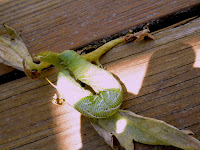 Yesterday a friend asked me how to get rid of them. Really, the best way is to pick them off (watch out for the horns!) and dispose of them in the trash. You can try BT (Bacillius thuringiensis) dust (Dipel), but it is not very ineffective, particularly if they are full grown. I only recommend this if you have many plants and a severe infestation.
The other major tomato pest out there right now (my own personal enemy at the moment!) is a black and red creature known as a leaf-footed or squash bug. The best treatment advice is to vacuum them up (or bag 'em and trash 'em). I had taken my plants out to the driveway and sprayed them when I first found them congregating and they were small. Wish I had just bagged them then...they (or others) have found their way back to my plant and are sucking out the beautiful red color of my tomatoes.
Yesterday a friend asked me how to get rid of them. Really, the best way is to pick them off (watch out for the horns!) and dispose of them in the trash. You can try BT (Bacillius thuringiensis) dust (Dipel), but it is not very ineffective, particularly if they are full grown. I only recommend this if you have many plants and a severe infestation.
The other major tomato pest out there right now (my own personal enemy at the moment!) is a black and red creature known as a leaf-footed or squash bug. The best treatment advice is to vacuum them up (or bag 'em and trash 'em). I had taken my plants out to the driveway and sprayed them when I first found them congregating and they were small. Wish I had just bagged them then...they (or others) have found their way back to my plant and are sucking out the beautiful red color of my tomatoes.
I really don't recommend the chemical treatment for either of these pests...you really don't want the byproduct in your food, do you? Check them daily, be vigilant and accept a slightly less than perfect tomato that is probably still better tasting - and better for your health - than the one you can buy in the store. simple may be better.
Soon time to start a fall garden with leafy veggies. Also, select your favorite seeds for fall flowers among the zinnias, cleome, marigold and cosmos. Don't forget fall crocus bulbs as well.
More later,
Lyn
 Yesterday a friend asked me how to get rid of them. Really, the best way is to pick them off (watch out for the horns!) and dispose of them in the trash. You can try BT (Bacillius thuringiensis) dust (Dipel), but it is not very ineffective, particularly if they are full grown. I only recommend this if you have many plants and a severe infestation.
The other major tomato pest out there right now (my own personal enemy at the moment!) is a black and red creature known as a leaf-footed or squash bug. The best treatment advice is to vacuum them up (or bag 'em and trash 'em). I had taken my plants out to the driveway and sprayed them when I first found them congregating and they were small. Wish I had just bagged them then...they (or others) have found their way back to my plant and are sucking out the beautiful red color of my tomatoes.
Yesterday a friend asked me how to get rid of them. Really, the best way is to pick them off (watch out for the horns!) and dispose of them in the trash. You can try BT (Bacillius thuringiensis) dust (Dipel), but it is not very ineffective, particularly if they are full grown. I only recommend this if you have many plants and a severe infestation.
The other major tomato pest out there right now (my own personal enemy at the moment!) is a black and red creature known as a leaf-footed or squash bug. The best treatment advice is to vacuum them up (or bag 'em and trash 'em). I had taken my plants out to the driveway and sprayed them when I first found them congregating and they were small. Wish I had just bagged them then...they (or others) have found their way back to my plant and are sucking out the beautiful red color of my tomatoes.I really don't recommend the chemical treatment for either of these pests...you really don't want the byproduct in your food, do you? Check them daily, be vigilant and accept a slightly less than perfect tomato that is probably still better tasting - and better for your health - than the one you can buy in the store. simple may be better.
Soon time to start a fall garden with leafy veggies. Also, select your favorite seeds for fall flowers among the zinnias, cleome, marigold and cosmos. Don't forget fall crocus bulbs as well.
More later,
Lyn
ALERT! Armyworms in the Turf

Generally, they do a little chewing and move on. But, if you have recently installed new sod or have new sprigs, they will be the first to be chewed up. The key is early identification, when they are still young...look for them early morning or very late in the day by pouring soapy water (1/2 oz dish soap per gallon water) over areas showing some skeletal leaves. If you find a population of young worms, you can still treat with a bio control like Bacillus thurengienses (Bt) product name Dipel. If they are advanced in size, you will need something stronger like Sevin.
All the details are at this link:
http://commodities.caes.uga.edu/turfgrass/georgiaturf/LandscapeAlert/Fall%20Armyworms%20(8-09).html
Good hunting! Lyn
Monday, August 9, 2010
Lawns in our life
From the ridiculous to the sublime...here are some facts about lawns:
800 million gallons of fuel are used in the US per year to cut lawns which equates to 5% of the US's total CO2 omissions, because lawn mowers are so inefficient!
2.5% of that 800 million gallons of fuel is spilt while trying to fill the lawn mower tanks which is equivalent to one Exxon Valdez oil spill per year.
(Statistics taken from a lecture by Alex MacLean, photographer and environmentalist, in March 2006)
And on the lighter side, here is a bit of humor:
http://www.comptechdoc.org/humor/garden/
Do we really need so much of it? What are your thoughts...
Lyn
Butterflies!

The butterflies are swarming on the Butterfly Bush (more like a tree :-)
Lots of nectar for them...


As much as I dislike the size of this plant in my small yard, I relish the butterflies!
Lyn
Saturday, August 7, 2010
Rain Barrels
These fast, fleeting summer showers are the perfect opportunity to be grabbing some free water for your garden...the only thing better is a deal on rain barrels!
Ran across this supplier, 2 for $80, all set up with a spigot, an overflow valve and a bug screen. Marietta at Sandy Plains Rd.
http://atlanta.craigslist.org/nat/grd/1885439370.html
As the AC bill goes up, at least there is something you can do about your water bill :-)
Lyn
Ran across this supplier, 2 for $80, all set up with a spigot, an overflow valve and a bug screen. Marietta at Sandy Plains Rd.
http://atlanta.craigslist.org/nat/grd/1885439370.html
As the AC bill goes up, at least there is something you can do about your water bill :-)
Lyn
Friday, August 6, 2010
Keep your roses blooming
August is the last month you should be applying fertilizer to your plants, so give them one last shot at blooms with an application this month of an organic such as fish emulsion. While you are at it, hit the container plants, too. I recently learned that is what they use at Butchart Gardens in Victoria, BC and they had the best looking containers I have ever seen! Be sure to water in well when first applied.
The other important ongoing chore for those of you with roses, is to keep the weeds and falling leaves out of the plant bed, and to deadhead the blooms. If you are having trouble with pests, try spraying with strong blast of water in early morning, followed by an insecticidal soap spray while the day is still young. (Never apply fertilizers or pesticides in the heat of the day.) If you need something stronger, try treating with Orthonex, which will work for both pests and fungus. I recommend using the organics first and if that doesn't work, move up to something stronger. Towards the end of the month, work in some Mills MagicTM to build up the soil quality before getting ready for fall and winter.

This is one of the beauties (Midas Touch, USA) from my recent trip to the northwest, where they have a lot of rain...a double edged sword with roses. Have a blooming great weekend! Lyn
The other important ongoing chore for those of you with roses, is to keep the weeds and falling leaves out of the plant bed, and to deadhead the blooms. If you are having trouble with pests, try spraying with strong blast of water in early morning, followed by an insecticidal soap spray while the day is still young. (Never apply fertilizers or pesticides in the heat of the day.) If you need something stronger, try treating with Orthonex, which will work for both pests and fungus. I recommend using the organics first and if that doesn't work, move up to something stronger. Towards the end of the month, work in some Mills MagicTM to build up the soil quality before getting ready for fall and winter.

This is one of the beauties (Midas Touch, USA) from my recent trip to the northwest, where they have a lot of rain...a double edged sword with roses. Have a blooming great weekend! Lyn
Subscribe to:
Posts (Atom)


