
A landscape friend recently reminded me of a successful formula for keeping the deer away from your plants.
This tends to be a real problem, particularly in the suburbs in a year or period of low rainfall. Although our year started off with lots of rain, the drier season of late summer is putting more stress on animals to find food and water (sometimes only through food).
A soil amendment and fertilizer, known as Milorganite, is actually made from sewage sludge. I know, you are turning up your nose -- but so are the deer! Actually, the filtering process makes this a very worthwhile organic fertilizer and top dressing. If you will cut the corner of the bag and spread 1-2" around the plant, it will repel the deer. Applying a light sprinkling of water will 'activate' the scent and add an extra level of protection.
If you are having trouble with rabbits, the dry version of Repels All is said to be an effective treatment.
Let me know your success with these products. It's been a while since I had to be concerned with the varmints...
Lyn
Wednesday, August 18, 2010


Wednesday, August 11, 2010
Insects on your tomatoes
About a month ago, I posted a notice to watch for the tomato hornworm on your plants. They are very hard to spot as they match the leaf color so well.
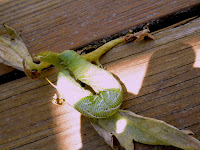 Yesterday a friend asked me how to get rid of them. Really, the best way is to pick them off (watch out for the horns!) and dispose of them in the trash. You can try BT (Bacillius thuringiensis) dust (Dipel), but it is not very ineffective, particularly if they are full grown. I only recommend this if you have many plants and a severe infestation.
The other major tomato pest out there right now (my own personal enemy at the moment!) is a black and red creature known as a leaf-footed or squash bug. The best treatment advice is to vacuum them up (or bag 'em and trash 'em). I had taken my plants out to the driveway and sprayed them when I first found them congregating and they were small. Wish I had just bagged them then...they (or others) have found their way back to my plant and are sucking out the beautiful red color of my tomatoes.
Yesterday a friend asked me how to get rid of them. Really, the best way is to pick them off (watch out for the horns!) and dispose of them in the trash. You can try BT (Bacillius thuringiensis) dust (Dipel), but it is not very ineffective, particularly if they are full grown. I only recommend this if you have many plants and a severe infestation.
The other major tomato pest out there right now (my own personal enemy at the moment!) is a black and red creature known as a leaf-footed or squash bug. The best treatment advice is to vacuum them up (or bag 'em and trash 'em). I had taken my plants out to the driveway and sprayed them when I first found them congregating and they were small. Wish I had just bagged them then...they (or others) have found their way back to my plant and are sucking out the beautiful red color of my tomatoes.
I really don't recommend the chemical treatment for either of these pests...you really don't want the byproduct in your food, do you? Check them daily, be vigilant and accept a slightly less than perfect tomato that is probably still better tasting - and better for your health - than the one you can buy in the store. simple may be better.
Soon time to start a fall garden with leafy veggies. Also, select your favorite seeds for fall flowers among the zinnias, cleome, marigold and cosmos. Don't forget fall crocus bulbs as well.
More later,
Lyn
 Yesterday a friend asked me how to get rid of them. Really, the best way is to pick them off (watch out for the horns!) and dispose of them in the trash. You can try BT (Bacillius thuringiensis) dust (Dipel), but it is not very ineffective, particularly if they are full grown. I only recommend this if you have many plants and a severe infestation.
The other major tomato pest out there right now (my own personal enemy at the moment!) is a black and red creature known as a leaf-footed or squash bug. The best treatment advice is to vacuum them up (or bag 'em and trash 'em). I had taken my plants out to the driveway and sprayed them when I first found them congregating and they were small. Wish I had just bagged them then...they (or others) have found their way back to my plant and are sucking out the beautiful red color of my tomatoes.
Yesterday a friend asked me how to get rid of them. Really, the best way is to pick them off (watch out for the horns!) and dispose of them in the trash. You can try BT (Bacillius thuringiensis) dust (Dipel), but it is not very ineffective, particularly if they are full grown. I only recommend this if you have many plants and a severe infestation.
The other major tomato pest out there right now (my own personal enemy at the moment!) is a black and red creature known as a leaf-footed or squash bug. The best treatment advice is to vacuum them up (or bag 'em and trash 'em). I had taken my plants out to the driveway and sprayed them when I first found them congregating and they were small. Wish I had just bagged them then...they (or others) have found their way back to my plant and are sucking out the beautiful red color of my tomatoes.I really don't recommend the chemical treatment for either of these pests...you really don't want the byproduct in your food, do you? Check them daily, be vigilant and accept a slightly less than perfect tomato that is probably still better tasting - and better for your health - than the one you can buy in the store. simple may be better.
Soon time to start a fall garden with leafy veggies. Also, select your favorite seeds for fall flowers among the zinnias, cleome, marigold and cosmos. Don't forget fall crocus bulbs as well.
More later,
Lyn
ALERT! Armyworms in the Turf

Generally, they do a little chewing and move on. But, if you have recently installed new sod or have new sprigs, they will be the first to be chewed up. The key is early identification, when they are still young...look for them early morning or very late in the day by pouring soapy water (1/2 oz dish soap per gallon water) over areas showing some skeletal leaves. If you find a population of young worms, you can still treat with a bio control like Bacillus thurengienses (Bt) product name Dipel. If they are advanced in size, you will need something stronger like Sevin.
All the details are at this link:
http://commodities.caes.uga.edu/turfgrass/georgiaturf/LandscapeAlert/Fall%20Armyworms%20(8-09).html
Good hunting! Lyn
Monday, August 9, 2010
Lawns in our life
From the ridiculous to the sublime...here are some facts about lawns:
800 million gallons of fuel are used in the US per year to cut lawns which equates to 5% of the US's total CO2 omissions, because lawn mowers are so inefficient!
2.5% of that 800 million gallons of fuel is spilt while trying to fill the lawn mower tanks which is equivalent to one Exxon Valdez oil spill per year.
(Statistics taken from a lecture by Alex MacLean, photographer and environmentalist, in March 2006)
And on the lighter side, here is a bit of humor:
http://www.comptechdoc.org/humor/garden/
Do we really need so much of it? What are your thoughts...
Lyn
Subscribe to:
Posts (Atom)


